On the referendum #15: Good news, Cameron changes the question – and a new poll

Today the Electoral Commission said the question should be framed as stay/leave rather than yes/no. (They have given similar advice before.) The government knew about the announcement beforehand and immediately announced they agreed. This is good news.

Cameron has been persuaded that his original desire to be the YES campaign was an error. It is unclear to me whether this nudges things in his direction or not. There are reasonable arguments either way. I suspect it will not help either side much. More importantly, I think clarity about stay/leave will avoid the confusion that I had already noticed with Yes/No, so regardless of which side it helps (if any) it is better for the public debate for this element of confusion to be eliminated.

One of the reasons why we decided in June to revive the old ‘no’ campaign logo and branding from the euro campaign 1999-2002 was so that we could get going fast without having to spend a penny on branding and without having to worry about the question being changed as it went through Parliament. When we discussed it we thought it unlikely this would happen but worth guarding against, particularly given branding processes can be expensive as well as nightmarish. The announcement today therefore is unexpected good news because of the clarity and hasn’t cost us anything.

The referendum will rest on whether the third of the public that dislikes the EU and would like to leave are persuaded that they have little to fear in terms of their jobs and living standards and that a vote to STAY is at least as risky as a vote to LEAVE given the long-term dynamics of the EU grabbing more money and power every year and planning a new Treaty after the referendum. If they are so persuaded, we will win by at least 65%. If they are not, we will lose roughly 65:35. If they split 50:50 it will be close.

Now, few MPs have heard of the Five Presidents Report and the Commission’s plan for a new Treaty (part of the reason is that it was published at the same time as the Tunisia terrorist attacks so it got almost zero coverage). When the vote happens, most of the country will know about it. Now, almost nobody in the country has heard of the EU’s Charter of Fundamental Rights which gives the ECJ more power over Britain than the Supreme Court has over US states, and which Blair promised would have ‘no more legal effect than the Sun or the Beano‘. (NB. this is NOT the ECHR which is justiciable in the Strasbourg court). When the vote happens, most of the country will know about it. STAY will not seem like the safe status quo because it is not a safe status quo. The EU is inexorably changing as it always planned to do, adapting to the long-term plan for the euro to drive ‘political union’ – a plan that the Foreign Office understands very well but which it has masked for decades with propaganda about ‘3 million jobs’ and so on.

The choice is not between ‘a safe status quo’ and ‘a risky leap’. The choice is between whether you think it is riskier a) to keep giving away control and money to an organisation that cannot cope with the economic and technological forces changing the world, and cannot use the power it already has wisely yet wants even more power to prop up the euro, or b) to take back control and money and negotiate a new deal based on free trade and closer international cooperation with our European friends and other countries around the world.

NB. The 5 Presidents Report and the Commission’s timetable also opens up  a wild card option for Cameron that I will blog on soon…


UPDATE

Half an hour after writing the above I got this poll back from ICM.

Coincidentally, given today’s news, I asked ICM to ask a question over the weekend to probe attitudes.

The standard tracker question on the (now) ‘old’ official question shows 46(+2):35(-2) for YES, bang in the region where it has been for weeks.

We asked another question:

‘Which of the following best reflects your view?

A) I am not worried about the UK leaving the EU because I believe it can negotiate a free trade deal with the EU, and carry on cooperating in a friendly way from outside the EU.

B) I am worried about the UK leaving the EU because I believe that outside the EU it will not be able to negotiate a free trade deal and cooperate in a friendly way.’

The headline figure is 43:40 for (a), i.e. neck and neck (within margin of error).

If you look at the crossbreaks, it shows that the 43% who say YES break 76:14 for B, while the 35% who say NO break 90:4 for A.

This is interesting. Lots of polling shows the public divide roughly into a third definite OUT, a quarter to a third definite IN, and about a third who dislike the EU and would like to be out but are worried about leaving because of fears over jobs and living standards.

Today’s poll suggests that if more people are persuaded that we can get a new deal based on free trade and friendly cooperation, then the headline voting number could swing our way quite significantly.

Of course this will be hard. There is substantial fear that, I think, is unjustified. Whether you are pro/anti the EU it ought to be clear that Britain can have a free trade deal and cooperate from outside as other countries in Europe and elsewhere do.

All those who think like me that the EU cannot cope with the profound economic and technological transitions reshaping the world should reflect on this. We need to present a picture of how the world could be organised much better, with 1950s bureaucracies like the EU replaced with dynamic institutions that can adapt fast and fix their errors rapidly. If we sit around discussing ‘gene drives’ in Brussels committees the way we’ve sat around discussing the ludicrous CAP for fifty years, we are in big trouble. We deserve better and we can do much better than the EU. We need to explain how.


On the referendum #14: latest ICM poll, numbers move slightly toward NO but normal variation

ICM is doing an omnibus question regularly now on the precise referendum question.

HERE is a PDF of their latest poll of 2,000 people conducted over 21-23 August.

Headline figures: Yes 44 (-4), No 37 (+3), Don’t know 19. This change is probably normal variation in a random sample.

In this poll, Scotland’s figures are closer to the average: 49 – 30.

The strong lead for YES among ABs remains: 55(-5) – 30(+5).

On the referendum #13: new ICM poll shows growing support for Yes/In; couple of other thoughts on education and judgement

ICM is doing an omnibus question regularly now on the precise referendum question.

HERE is a PDF of their latest poll of 2,000 people conducted over 14-16 August.

Headline figures: Yes 48 (+2), No 34 (-2), Don’t know 19.

In this poll, Scotland has much more divergent figures than the previous one: 56-26. I assume this is a combination of a small sample (170) and normal statistical variance…?

The strong lead for YES among ABs is even stronger: 60(+2) – 25(-5).

Two other brief thoughts on the issue of why more educated people often make huge errors of judgement, perhaps the best example of which being the way in which the best educated were the most suckered by Soviet propaganda and most resistant to the truth about Stalin’s terror, the Ukrainian famine etc (see Orwell’s famous essays).

1. Thucydides and simplicity.

One of the best bits in Thucydides is his account of the civil wars that wracked Greece. In that account is this passage:

‘Thus revolution gave birth to every form of wickedness in Greece. The simplicity which is so large an element in a noble nature was laughed to scorn and disappeared… In general, the dishonest more easily gain credit for cleverness than the simple do for goodness; men take pride in one, but are ashamed of the other… At such a time, the life of the city was all in disorder, and human nature, which is always ready to transgress the laws, having now trampled them under foot, delighted to show that her passions were ungovernable, that she was stronger than justice, and the enemy of everything above her… When men are retaliating upon others, they are reckless of the future and do not hesitate to annul those common laws of humanity to which every individual trusts for his own hope of deliverance should he ever be overtaken by calamity; they forget that in their own hour of need they will look for them in vain… The cause of all these evils was the love of power, originating in avarice and ambition, and the party-spirit which is engendered by them when men are fairly embarked in a contest… For party associations are not based upon any established law nor do they seek the public good; they are formed in defiance of the laws and from self-interest…’  Book III, Jowett translation.

‘The simplicity which is so large an element in a noble nature…’ Intelligence is not just necessary for some things – in some areas such as maths and physics it is directly related to achievements. Politics is very different.

Thucydides reminds us that morality is not positively correlated with intelligence. Some modern evidence even suggests that more intelligent people are less compassionate (see my Essay).

2. Timescales and priorities.

A physicist emailed re my last blog to point out that richer and better educated people are less susceptible to physical disruption and economic disaster. Poorer people have to be more cautious.

Many people I know are very happy with the immigration policy of the last 15 years. They have gained a lot and see no risks to them. Their visits to doctors are unaffected. They hire cheap foreign nannies. They can afford to take positions based on moral signalling because they are cushioned against harsh reality – hence their vocal support for the euro at dinner parties while less educated people said things like ‘they’ll use it to put up prices like with decimalisation’. They have little or no idea what it’s like to struggle on £18,000 a year in a part of Birmingham that has been radically changed by immigration in a short period knowing one has no reserves to call on. The BBC and other influential institutions are dominated by such people so it is almost inevitable that they see issues like the EU in ways that seem distorted to others.

Another feature of richer people in my experience is that they tend to think that their greater wealth is a consequence of their virtues – they don’t seem to reflect much on the genetic roll of the dice. This is another subject…


On the referendum #12: new ICM poll shows 46-36 for staying in the EU; education, BBC, propaganda, Willie Munzenberg

ICM are going to be asking the referendum question regularly from now on.

HERE is their latest poll of 2,000 over 31 July – 3 August.

The headline figure is 46-36 for YES.

One of the interesting categories is Scotland which has 47-35 for YES. This is contrary to other polls that have shown much wider YES margins in Scotland. I wonder what the truth is about Scottish opinion.

Also note how ABs, better educated than other social groups, are 58:30 for YES.

Another interesting recent poll was done by Survation coinciding with the Farage speech / Arron Banks ‘in the know’ advertising push. The analysis is HERE. The numbers confirm the conclusions I sketched on public opinion last summer based on focus groups.

All the polls show that support for leaving the EU has fallen towards a core vote of about a third of the public. There is no doubt that the NO campaign is in a very difficult position. Some of those who want to leave have made some big errors and the establishment is largely united behind IN. Worse, OUT has become associated with an unattractive moral feeling. Better educated people tend to get their political views from feelings, mood, Zeitgeist and fashion, hence the success of the most brilliant propagandists – the Communists of the early part of the 20th century who dazzled large sections of the intelligentsia: see the career of Karl Radek’s frighteningly effective agent Willie Munzenberg (connected to all sorts of people from Hemingway to Philby et al) and characters such as Otto Katz, the NKVD agent who said ‘Columbus discovered America, I discovered Hollywood.’

It is a mistake to think that the better educated are ‘more rational’ in their political analysis; often they are less rational and more affected by fashion than the un-educated. They also run influential cultural institutions. Much of the techniques of Soviet propaganda (which became the basis for most of modern PR such as the celebrity letterhead) rely on one principle – how to overwhelm reason and humans’ capacity for objective analysis by creating a moral picture such that people send little moral signals to each other by their actions (like those well-educated people who signal each other by attacking the Mail on Twitter).

These phenomena are relevant to the referendum. As one famous BBC correspondent said to us during the euro battle, ‘The thing is we [the BBC] like cappuccinos and hate racists.’ Such feelings tend to overwhelm reason and leave people blind to things that ought to be obvious – e.g. that Delors et al created the euro in order to spark a great leap forward for ‘political union’ and its institutional structure was sub-optimal and risky when they created it (an argument that was perceived as near-loony by many at the BBC for years).

It has been conventional wisdom among the better-educated who control powerful cultural institutions that support for the EU is synonymous with being ‘modern’, ‘not racist’ and so on. This is despite the EU system looking in many ways extremely dated, palpably failing, transferring money from the poor to the rich and multinationals etc. My point is not at all that I am right about the faults of the EU; perhaps my arguments are poor. My point is that there is a morally and intellectually respectable argument that the EU is an outdated bureaucratic mess, built on very dodgy intellectual foundations by Jean Monnet, and supported now by trite soundbites about ‘3 million jobs’ that do not hold up to serious scrutiny – but that the history, ideas, arguments etc count for very little against feelings, and they often count least among the well-educated.

Changing this moral picture such that people think about the issues, rather than adopt positions based on moral signals and emotion, will be extremely hard for the NO campaign in the time available though I do think that the silent artillery of time will change it within a decade.

Ps. I should add that there are two strong emotions on the NO side, regarding immigration and contempt for political elites, which also can lead to faulty reasoning.

Pps. (Added later). Patrick Wintour, the Guardian’s political editor, comments on Twitter that the above ‘may underplay possible Labour volte face.’ He is right. My impression is that the sight of the Bundesbank telling the Greeks to transfer assets to an offshore trust to be privatised by Germany has opened the eyes of some on the democratic Left to the deep institutional problems of the euro and the consequences of the push for economic and political union. However, this is a very recent development. Many on the Left have not thought seriously about the EU since Delors’ extremely clever speech to the TUC in 1988 which explained to the Left how the EU could be used to achieve permanent victory over their political opponents at a time when Thatcherism seemed dominant. Most political speeches are a waste of time. This is one of the few that really changed politics. Many on the Left decided to prioritise unravelling Thatcherism over democratic accountability as a consequence of this speech.

I hope that Labour does, as PW suggests, re-examine its uncritical support for the EU project particularly given it is now heading for yet another Treaty (between our referendum and 2025) based explicitly on the Delors model that will centralise much more power in Brussels in an attempt to prop the euro up and continue the Monnet/Delors vision (see HERE). There are some great Labour MPs, such as Gisela Stuart, who have challenged the conventional wisdom in Labour for years. Other figures in Labour, such as Blair’s speechwriter Phil Collins, really seem to believe the Foreign Office spin that ‘the EU is changing, the Monnet/Delors model is dead’ etc. The Foreign Office knows this is rubbish – the Five Presidents Report makes it untenable – but it is amazing how many intelligent British people choose to believe this time after time. I remember Mandelson saying exactly the same about the ‘Madrid Agenda 2000’ around the same time he was predicting the euro would be great for Ireland and Greece. Actually, this connects directly to the main point above about the delusions of the educated.

On the referendum #11: new ICM poll on a second referendum idea, Boris etc

A few weeks ago I wrote a blog on the issue of exit plans and a possible second referendum. According to various media reports, Boris liked the idea and has told people so.

I thought it would be interesting to see some numbers so asked ICM to consider it.

Attached HERE are the results.

Unsurprisingly, they show that 1) the public supports a second referendum, and 2) the prospect of one makes the idea of voting NO in the first vote less scary and therefore may increase the chances of NO winning the first vote.

It is also worth considering that the public has not focused on the first vote yet so the idea of a second vote is necessarily an abstract and hazy thing. As the campaign develops, I suspect these numbers will strengthen.

I have a few thoughts about this though no time to sketch them now, but I thought it would be useful for people to look at some numbers.

NB. It is not for me to decide what the NO campaign position should be on a second referendum and I have not decided what I think about it, but the 5 Presidents Report, the Hollande interview today on the need for another Delors-esque great leap forward etc show how important it is for these things to be thought through quickly…

Please leave thoughts below.

On the referendum #10: Do you want to be a hammer or an anvil? Building a team for the NO campaign

‘Better to be a hammer than an anvil… If revolution there is to be, better to undertake it than undergo it.’ Bismarck

Some Tory MPs have said ‘we must wait for the prime minister to return from his renegotiation before we talk about a NO campaign, we cannot prejudge it, party unity demands…’ No, no, no.

Those who care about this issue need to consider a basic organisational issue.

Creating a ~£10-20+ million organisation that can fight the biggest political campaign in decades is not something that can be done in the 8-16 weeks that may elapse between a) Cameron returning from his climactic EU Council declaring ‘victory’ over the dastardly foreigners and  b) the vote.

Such an organisation needs strong, secure foundations. It needs to go from zero pounds and people to millions of pounds and thousands of people across the country. It needs to bring together all sorts of expertise from conventional Treasurers to very unconventional Facebook experts. It needs to build an old school grassroots network plugged into new technology.

Building this organisation should have started years ago. The resources of the old anti-euro campaign should have gone into working out a roadmap for a new UK-EU treaty and building a national movement to support it. It did not happen. Resources were diverted into cul-de-sacs. It cannot be delayed further.

Such a thing cannot be done in a few weeks. It will be a huge challenge to do it effectively in perhaps just 10-18 months. Saying that a NO campaign should not be set up until Cameron declares victory is organisationally equivalent to saying ‘let’s give up now’. I thought it a mistake to try to force David Cameron to hold a referendum but for those who ignored the dangers and pushed for it now to argue that ‘we must wait before we do anything’ is no good.

Further, there is an important point about how the referendum must be treated. Many Conservatives realise this but some don’t. We must focus on the interests of Britain, Europe, and the wider world – not party interests, including ‘party unity’.

All sorts of things are ‘good for party unity’ in the short-term and awful for everyone in the long-term. Those arguing that the interests of the NO campaign be subordinated to the interests of Conservative Party ‘unity’ are just as wrong as those in UKIP arguing that the interests of the NO campaign be subordinated to UKIP’s electoral interests in 2020.

A serious NO campaign that can set out the issues properly must be organised without regard to any party interests, though with sensitivity to different party loyalties.

The vote may be in April – just 8 months after people return from summer holidays. There is no more time to waste.

*

Building a team

‘We would rather suffer the visible costs of a few bad decisions than incur the many invisible costs that come from decisions made too slowly – or not at all – because of a stifling bureaucracy.’ Warren Buffet

As I wrote HERE, I’ve been asked to help recruit people for the referendum. A lot of things have happened over the past few weeks. We are starting to recruit people.

Paul Stephenson is one of the best people in the country at dealing with the media. He has agreed to join the campaign. Others have agreed to help with communications but are not public yet.

We need a lot of different skills. Some of this process must be secret but not all…

– Researchers. We need researchers of different levels of seniority. Some people who have worked on this area for a long time and know it inside out. Others who are young, clever, willing to work crazy hours, and aren’t worried about upsetting a whole load of powerful people, from Whitehall to Goldman Sachs to Brussels.

– Programmers / web designers / digital media etc. British politics is decades behind other countries on advertising, TV etc (partly because of the ban on TV political advertising); if you read the Selling of the President, you will see that No10 and Labour have not caught up to 1968-level sophistication in dealing with visuals. It is also way behind on the internet. This campaign requires innovation and will suck in the resources to allow it. If you are a web designer, an expert in social media, or a computer scientist motivated to help, then please get in touch.

– Advertising, marketing, direct mail, creative design. Have you read William Gibson’s Pattern Recognition or Spook Country? If you work on brands like Tommy Hillfigger – do NOT get in touch with us, go call David Cameron! If you fancy yourself as Cayce Pollard or Hubertus Bigend, if you think your agency is a real life Blue Ant, then we want to speak to you. If you have used Palantir for political campaigns, then we want to speak to you. The NO campaign will have to create an eclectic network of cognitive scientists, marketing people and so on.

Do you want to create something as iconic as this for the NO campaign?

Eisenstein’s ‘October’

Or this?

The daisy ad

Or this?

‘1984’

If yes, get in touch…

(NB. Apple now is routinely touted as the best company in the world at advertising stemming from Jobs’ highly unusual personal taste. When the ‘1984’ advert, one of the most iconic adverts ever made, was first shown to the Apple board, the reaction was – let’s fire this ad agency and get a new one. Cf. Isaacson, p.163.)

– Spokespeople. We need fresh faces. We’ll probably build our own studio in the office that can beam out broadcast quality stuff. If you’re on our side, smart as hell, and fancy yourself a cross between Bill Clinton and Milla Jovovich, get in touch. If you know someone like this on our side, tell them to get in touch.

– Grassroots. We are not yet in a position to deal with grassroots volunteers but we should be by September, hopefully. If you want to help here, start building your own network, figure out how to use Facebook to mobilise people you know to persuade people they know. When we have an infrastructure, you’ll be able to plug into it. This campaign needs to build distributed networks fast in all sorts of ways that have not been done in UK politics. It cannot be a traditional centralised campaign in which supposed wisdom flows from the centre to the edges of the network. Instead, it must apply lessons learned by others: e.g. how the intelligence world has changed over the past decade.

– We will need all sorts of expertise not listed here. We are trying to create a core infrastructure that can use your help, watch this space for further details…

*

Simplification

‘The way we’re running the company, the product design, the advertising, it all comes down to this: Let’s make it simple. Really simple.’ Steve Jobs

‘Peace, bread, land.’ Famous Soviet slogan

Here is an example of simplification that works:

When Steve Jobs returned to a nearly bankrupt Apple in 1997, the once-famous brand was failing. It had no focus, was trying to do far too much, it had lost leadership, and suffered dysfunctional decision-making. Jobs simplified and focused. ‘The product lineup was too complicated and the company was bleeding cash. A friend of the family asked me which Apple computer she should buy. She couldn’t figure it out and I couldn’t give her clear guidance either’ (Jobs). ‘After a few weeks Jobs finally had enough. “Stop!” he shouted at one big product strategy session. “This is crazy.” He grabbed a magic marker, padded to a whiteboard, and drew a horizontal and vertical line to make a four-squared chart. “Here’s what we need,” he continued. Atop the two columns he wrote “Consumer” and “Pro”; he labeled the two rows “Desktop” and “Portable.” Their job, he said, was to make four great products, one for each quadrant’ (Isaacson). He cut all printers and other peripherals. He cut development engineers and software development. He cut distributors and five of the six national retailers. He moved almost all manufacturing offshore to Taiwan. He cut inventory by 80% and began selling directly over the internet (Rumelt).

Whitehall needs this treatment but won’t get it.

The ‘eurosceptic movement’ needs this treatment.

There is huge duplication. The same things are reinvented in dizzying proliferation. Not even the MPs and hacks who are supposed to be following the details can follow what people are doing. This means that the chances of the public following are ZERO.

NB. The net effect on public psychology of a decade of Cameron speeches on all sorts of issues from the NHS to schools to Europe is…? Approximately zero, as market research shows. This is because Cameron did not work on the basis of paying very careful attention to how people think and what arguments work, and shied away from (without properly considering) arguments that could get through to the public. Cameron focused on arguments of interest to pundits – not the public. How did he stagger to a tiny victory over the useless Miliband? Because he put his fate in the hands of someone who dropped everything else the Party was doing and persuaded a crucial section of the public that they were about to have their money stolen by the Scots. It worked, just, against Miliband but is hardly a model of political communication that Roosevelt or Reagan would be happy with.

The point is not about Cameron, it is about our campaign: if the most prominent politician of the last decade can give speech after speech leading the news and have a trivial effect on mass psychology, this ought to strike the fear of God into eurosceptics because people know almost nothing about EU arguments and status quo campaigns usually win. Only a radically different approach will give even a chance of victory.

The NO campaign will need to make arguments that we know are comprehensible and effective. This requires huge discipline, simplification, and focus. We don’t need 18 different people writing their own notes on trade, using slightly different figures and very different arguments, that are read by the same 18 people but ignored even by people who are paid to pay attention. We need to break out of the ghetto.

Everything will need to be pared down to a few fundamental objectives such as: neutralising fear of NO, explaining the gains from regaining control, explaining the costs and dangers of continuing to give away control, and developing a feeling in the country that NO would not just be good for us but good for the world. It will also require avoiding language that confuses. For example, the word ‘sovereignty’ is for many people ‘something to do with the queen’. Stop using it.

And it will require some game changers, of which a second referendum is, perhaps, one.

*

The NO campaign is, obviously, a massive underdog. Almost everyone in SW1 thinks it is doomed. However, SW1 conventional wisdom is often wrong. Many pundits thought joining the euro ‘inevitable’. Nobody thought we could stop Blair in the referendum on the North East Regional Assembly. We won 80-20. I cannot remember a single pundit who thought Gove’s team would change half what we changed.

Referendums are volatile. There is a huge undercurrent of opinion in this country that is deeply hostile to the established parties and desperate for a chance to hit a REBOOT BUTTON on Whitehall and Westminster. The structural wiring of the British state makes it very hard for political entrepreneurs to get a foothold. This campaign gives people who want things to change a chance to do things very differently. If we vote NO, we could do an awful lot to improve not just prosperity but also democratic government and the cause of international cooperation. We could, perhaps, help make a transition from the 1950s era that spawned the bureaucratic centralism of the EEC to a new desperately needed era of decentralised problem-solving networks that we need to help solve humanity’s challenges and exploit the tremendous properties of science and markets (cf. the work of physicist Dirk Helbing at Zurich University).

This campaign will require a lot of risks and some luck. If we fail, we will not fail conventionally – we won’t have bought IBM to avoid looking stupid…

If you are interested, please email dmc2.cummings@gmail.com

Finally, you don’t have to worry about working for me because I am NOT ‘running the NO campaign’ whatever you read. I don’t have the brains, skills, or personality. I am helping establish some foundations and a core team and helping people focus on essentials. One of the essentials is getting the right people. For such a huge event all sorts of extremely talented people will come out of the woodwork. Some of them will be unknown 20 year-olds who will run rings around people like me and supposed ‘grandees’ who’ve been on TV for decades and are so out of touch with how the world works they still think the EU is ‘modern’ (e.g. Ken Clarke). Once things are moving, I will be returning to my studies, helping in minor ways only.

Finally finally – pay. I don’t think anybody working in the campaign should be paid a six figure salary. For many years I’ve watched overpaid people in politics and Whitehall do a rubbish job and walk home with fat salaries while 25 year olds could do their job much better for less than half the cost. SW1 swarms with clueless people on £120k+. I’ve argued for over a decade, to zero effect because the parties are so out of touch, that the rules on executive pay for public companies are a joke. In the DfE I tried and largely failed to tackle grotesque overpaying and to promote young people into jobs held by people on six figures who squandered taxpayers’ money. People (including shareholders) don’t mind entrepreneurs getting rich. They rightly object to hired managers paid like successful entrepreneurs. This campaign should focus money on winning, not making staff rich. We should set an example. People say – ‘you won’t attract the talent’. Wrong. The only people we’ll lose are people we don’t want. If you want to get overpaid for lying to people, call the EU Commission or Roland Rudd – he tells the media he wants to pay his campaign manager 500k: you can hire 20 junior people for that and I’ll bet they’ll drive the guy on 500k round the bend before they’re done…

Book review: How to run a Government, by Michael Barber

I wrote a review of Michael Barber’s book, How to Run a Government, for the Spectator a few months ago. Here is the text.

One fact check. Early in the book Michael writes that Magnus Carlsen, the world chess champion, can beat the best chess computers because ‘the eagle of computer analysis soars to a great height, and then the wren of human judgement, sitting on the eagle’s back, can fly that bit higher.’ Alas the wren of human judgement slides off the back of the eagle and falls – plunk – to the ground. The best chess computers now play at a level far above any human, their tactical battles like light-sabre duels on mountain tops, one false move spelling instant death.

On a connected theme, it is interesting that experiments with humans + brilliant computer versus brilliant computer show that strategic use of computers by humans can lead to better performance than the computer can manage alone. I don’t know the results from the latest experiments – Kasparov wrote a fascinating piece in the NYRB a while ago – but if this holds it will give clues about other possible man-robot collaborations.

*

How to Run a Government, Michael Barber

Allen Lane, pp.316, £16.99, ISBN: 9780241004975

In 2001, Tony Blair took Sir Michael Barber from his perch as special adviser in the Department for Education and brought him into Downing Street. Once there Barber set up Blair’s ‘Delivery Unit’ and oversaw his attempts to reform public services. He then moved to the McKinsey consultancy where he cloned his unit for governments around the world.

He has now written a book, How to Run a Government, about what he calls ‘deliverology’ — an ‘emerging science of delivery’. It is part memoir and part a ‘how to’ manual describing ‘a set of processes that enables governments to deliver ambitious goals’.

Steve Hilton, David Cameron’s adviser, is reported saying to Barber six months after the 2010 election: ‘I know we disparaged targets and delivery and all that when we were in opposition, but now we’ve been here a while, we have a question: how did you do it?’ Barber replied: ‘You’ve learned fast. It took Blair four years to learn the same thing.’ His book is an extended answer to Cameron and others who arrive in Downing Street ignorant of how to get anything done.

Barber summarises wisdom from hundreds of books about effective management. He explains the various systems his team have developed to take a politician’s agenda, break it into a series of priorities and processes, then chase each one relentlessly.

I have worked in Whitehall and dealt with a decrepit Downing Street and Sir Humphrey at his worst. I am sure that new ministers would learn from this book. Many will be more successful if they turn over their agenda to Barber’s consultants.

However, this book is not a manual on ‘how to run a government’. As Barber says, his approach is based on the assumption that his team ‘always knows more about what “good” or “bad” looks like in other, similar organisations’ than officials and MPs do. This is the heart of the problem. It is inconceivable that Barber’s consultants could go into a brilliantly managed company like Apple and know more than the CEO about ‘what good or bad looks like in similar organisations’.

His team gets results because they are picking very low-hanging fruit— they are providing what should be minimal competence for people who do not know how to prioritise and are managerially incompetent. He recalls realising that after all the promises made in the 2000 Spending Review ‘there was no plan’ to achieve them. This was ‘a seminal moment’ for him, and he started the necessary planning, but as he says: ‘Why wouldn’t any minister with a sense of purpose [do] this in the first couple of months in office?’ Quite.Barber, a nice man who believes the best of politicians, does not answer his own question.

He writes that the military’s success in dealing with the 2001 foot-and-mouth outbreak showed Blair the wonders of Cobra, the No. 10 disaster response system. When Blair faced a media storm over asylum seekers, he therefore turned to Cobra. For Barber, this is an example of successful ‘deliverology’. However, a prime minister using the terrorist crisis response system to grip a media storm over basic policy is not an example to be copied. It is a symptom of Whitehall’s profound dysfunction. It is similar to the way in which the London ambulance service now regularly uses the protocol for coping with terrorist attacks just to get through the day. It is a sign of a broken system, not a prescription for ‘how to run a government’.

Unfortunately, Barber explicitly advises MPs: ‘Don’t depend on generic civil service reform because you don’t have the time.’ This will get a very loud cheer from Sir Humphrey, but if we want serious government then we need fundamental changes in the way ministers and officials are selected, trained, paid, managed and held accountable. We need to reshape institutions so that they do not depend on sprinkling a layer of consultants on a broken bureaucracy to gerrymander management processes that ought to be in entry-level training for junior officials.

Barber’s ‘deliverology’ is better than government by spin and gimmick, but is only a recipe for forcing a few priorities through routinely incompetent bureaucracies. It is not a recipe for coping with the economic and technological forces, from drones to genetic engineering, that are disrupting society faster than our institutions can adapt. This requires replacing many Whitehall institutions with ones that can change as quickly as the world around them changes.

Available from the Spectator Bookshop, £13.99 Tel: 08430 600033

On the referendum #9: Cameron begins his renegotiation, the Commission sets out its timetable for new Treaty pre-2025, BJ & SJ make moves, a Greek ‘no’

A few thoughts on developments over the past week or so…

1. No Treaty change before the referendum. On Thursday 25th at the start of the EU Council, it emerged that Cameron officially dropped the idea of the EU treaties being changed before the referendum. His pledge that there will be ‘legally binding’ promises by the other 27 members to change the EU treaties in certain ways a few years in the future is a useful development for the NO campaign. No such promise will be believed regardless of the choreography. A future EU Treaty can be vetoed by any member and some members will also require a referendum. Nobody can guarantee in advance that a new Treaty will be agreed at all or on what terms, as the EU has found a few times already. A promise before the end of 2017 to change the treaties at some point in the future is the political equivalent of ‘the cheque’s in the post, and it will be paid in a few years time if 28 people still agree to pay it’. The NO campaign will be able to say simply, ‘If you trust all these politicians’ promises vote YES, if you suspect they may be lying as usual, vote NO to get a better deal.’ Polls will show strong distrust.

2. Trivial substantive demands from Cameron. The Guardian leak on Friday confirms how little Cameron is asking for. Do people in No10 really think that deleting phrases like ‘ever closer union’ and having the EU formally say ‘OK we won’t force you to join the euro’ would persuade people that the EU has fundamentally changed?! DC’s approach so far has been to send Llewellyn and Liddington around asking foreign governments ‘what should we ask for that you can give us?’ Unsurprisingly, this approach to negotiations is seen by other countries as consistent with Cameron’s lack of understanding of how EU business is done, as the Monnet-ist Foreign Office officials also ruefully acknowledge. There is no sign that the long-standing desire of Open Europe for a deal whereby Britain remains in the EU and Single Market but is outside all non-Single Market stuff is on the table or that No10 is pushing for it to be on the table.

3. The Commission plans its new Treaty to ‘complete’ Economic and Monetary Union before 2025. Meanwhile, as Cameron plays his role in the re-enactment of Wilson’s 1975 deceit, the Commission has its own timetable. It will be more influential than Britain’s. The Commission has, since Monnet, seen disasters as ‘beneficial crises’ – the answer to a crisis is always ‘more Europe’ (meaning ‘more centralised bureaucracy’). This was true after 9/11 and after the Madrid bombings. It was true after the 2008 financial crisis. It is true again now with the Greek crisis and the immigration crisis in the Mediterranean.

This paper, ‘Completing Europe’s Economic and Monetary Union’, was published on 22 June 2015. It got little coverage in the UK media. It was written by ‘the five presidents’: European Commission President Jean-Claude Juncker; the President of the Euro Summit, Donald Tusk; the President of the Eurogroup, Jeroen Dijsselbloem; the President of the European Central Bank, Mario Draghi; and the President of the European Parliament, Martin Schulz.

It sets out three stages for the ‘completion’ of Economic and Monetary Union by 2025, building on what it thinks is ‘a credible and stable currency’ to create a financial union, a fiscal union, and a political union, in three stages:

  • Stage 1) using existing treaties to push further including: single bank supervision, single bank resolution, single deposit insurance, a European Deposit Insurance Scheme (EDIS) at the European level, ‘further measures … to address the still significant margin for discretion at national level’ for bank regulation, a Capital Markets Union to ‘strengthen cross-border risk-sharing through deepening integration of bond and equity markets’, ‘harmonisation of accounting and auditing practices … addressing the most important bottlenecks preventing the integration of capital markets in areas like insolvency law, company law, property rights’, and a ‘system of Competitiveness Authorities … in charge of tracking performance and policies in the field of competitiveness’.
  • A White Paper in spring 2017 to set out the transition to Stage 2 outlining the legal measures needed to ‘complete’ EMU, following explicitly the model of the Delors White Paper of 1985 which paved the way to the Single European Act.
  • Stage 2) ‘a common macroeconomic stabilisation function’ to ‘improve the cushioning of large macroeconomic shocks’, maybe built on the European Fund for Strategic Investments, and a European Fiscal Board to ‘coordinate and complement the national fiscal councils that have been set up in the context of the EU Directive on budgetary frameworks’.
  • Stage 3) completion of EMU will involve further major steps towards a political union including ideas such as a ‘euro area treasury’ and unified external EU representation on international financial institutions such as the IMF.
  • This will require a new Treaty. It will also ‘require Member States to accept increasingly joint decision-making on elements of their respective national budgets and economic policies’.

Dominic Lawson’s column also shows the dismissive attitude of the German Europe Minister to Cameron’s renegotiation. Cameron has long had what is to me a baffling hope that Merkel both wants to and is able to solve all his European problems. This delusion is similar to many other unrealistic delusions about the EU held in the Foreign Office and Downing Street over the decades.

4. The EU Council dinner witnessed a huge row over the migrant crisis. Although the migrant crisis has been in the news, it is perhaps not appreciated just how much concern it is causing across Europe. (The terrorist attacks also diverted media attention.) The situation is dire, it will get worse as thousands of Africans head north for the coast, it is obvious that the EU’s institutions and laws cannot cope, signatories to Schengen are starting to introduce informal measures that are strictly illegal (e.g. French police checking papers of people coming from Italy contra the Schengen rules), and nobody can agree on what to do. Worried diplomats have described the shouting at the dinner as some of the worst scenes seen in decades. It seems likely that the Italian government will be forced to declare some sort of emergency state and start ignoring EU and ECHR law to a much greater extent than previously. This will create all sorts of dynamics that affect the UK referendum.

5. Boris backs a ‘NO’ vote and a second referendum to get a better deal. In a previous blog in this series, I discussed the issue of exit plans and a second referendum. According to a story by Shipman in the Sunday Times, Boris Johnson, after reading this blog, is considering that this may be the best path for him to take:

‘Boris Johnson is preparing to call for a “no” vote in Britain’s referendum on the European Union in an attempt to extract greater concessions from Brussels than David Cameron is demanding.

In a stance that puts him on a collision course with the prime minister, the mayor of London believes Britain should reject any deal Cameron puts forward because the EU will not give enough ground.

Johnson has told friends that a “no” vote is desirable because it would prompt Brussels to offer a much better deal, which the public could then support in a second referendum.

Johnson said: “We need to be bold. You have to show them that you are serious.”

The mayor’s views, shared with friends last week, will send shockwaves through Downing Street. Both the “yes” and “no” camps had assumed that he would support Cameron in arguing for Britain to vote yes.

Johnson made the comments after reading a blog by Dominic Cummings, the former Tory aide who is organising the “no” campaign, in which he argued that Eurosceptics should say: “If you want to say ‘stop’, vote no and you will get another chance to vote on the new deal.”

A friend of the mayor said: “I don’t think in his heart Boris wants us to walk away. But he’s interested in us saying no because it won’t be what we want. That would mean a second vote. He thinks the only way to deal with these people is to play hardball.”’

A Guardian story on Monday said that BJ sources confirmed the Shipman story and Forsyth’s Spectator story similarly confirmed it.

Since I blogged about this idea, many people have got in touch.

A. It seems likely to many people that a NO vote would have to be followed by a second referendum on a new deal because the scale of importance of the UK-EU agreement, dwarfing the issues in normal general elections, would require giving people a vote.

B. It is clear that escaping the supremacy of EU law enshrined in the 1972 European Communities Act will be a complicated process stretching over years – it will not be a simple event. A NO vote in the first referendum would not, as a matter of fact or law, mean we had left the EU or would immediately leave. It would in practice be a rejection of Cameron’s deal and a direction from the public for a new government team to negotiate a new deal.

C. This issue is entangled in the Conservative Party leadership campaign. Some leadership candidates will like the idea of a second referendum – it allows them to position themselves against Cameron’s deal without committing themselves to OUT.

They will be able to say, ‘David Cameron has got a bad deal that does not solve our problems on immigration or anything else, he’s wasted the historic opportunity handed him on a plate by the euro crisis and migrant crisis to negotiate a completely different European system, and if we vote NO we can get a better deal, we finally have a chance to do this properly’ etc.

D. If it becomes clearer that a NO vote will mean a second referendum on a new deal, then the probability of NO winning is likely to rise.

5. Sajid Javid tells the CBI that they are undermining efforts to reform the EU. SJ has previously said that leaving the EU is not something to be afraid of. SJ gave a speech to the CBI this week in which he said:

‘I heard that the CBI thinks the UK should remain in the European Union no matter what. That the people of Britain should vote to stay in regardless of whether or not the Prime Minister wins the concessions that British business so badly needs… [D]oes it really make sense to say, so early in the process, that ‘the rules of this club need to change, but don’t worry – we’ll always be members no matter what’?

‘You know how negotiation works. You wouldn’t sit down at the start of a merger or acquisition and, like a poker player showing his hand to the table, announce exactly what terms you were prepared to accept. It doesn’t work in the boardroom and it won’t work in Brussels.’

SJ is right. Polls have shown for over a decade that most businesses regard the costs of the EU and the Single Market as greater than the gains and want many more powers brought back than Cameron is now asking for (e.g. ICM, April 2004).

SJ could have added a historical lesson for the CBI about its long record of being wrong on big issues. Its forerunner advocated appeasement in the 1930s with the old ‘stability’ argument wheeled out. The CBI played an important role in pushing Britain into the disaster of the ERM. It tried to play an important tole in pushing Britain into the euro which would have been a disaster.

Fortunately, businesspeople like Stanley Kalms and Michael Edwardes formed Business for Sterling (which I worked for 1999-2002). We surveyed British businesses and proved that the CBI was lying about business opinion and was systematically cheating its own membership surveys to give the false impression to the FT and BBC that ‘British business overwhelmingly wants the euro’ – sound familiar? In fact big businesses were split and small businesses were hostile by about 2:1.

However, the power of the UK Government and the EU Commission makes it extremely hard for senior FTSE people to speak out against the EU while they get brownie points by backing the EU (cf. Branson who still speaks in support of Britain entering the euro). Many businesses were told in 1999 – if you support Business for Sterling, we will screw you. The same thing is happening now. Few journalists understand the politics of company boards whereby pro-EU people are licensed to speak out while anti-EU people are told to pipe down to avoid causing blowback.

Within a year of starting, by January 2000 we had forced the CBI to withdraw from the euro campaign.  Meanwhile the IOD and FSB were clearly hostile to the euro.

31 March 1999, Daily Telegraph: BfS/ICM poll showed business opposition to euro

2015-06-06 17.32.55

31 January 2000, FT: CBI withdraws from euro campaign
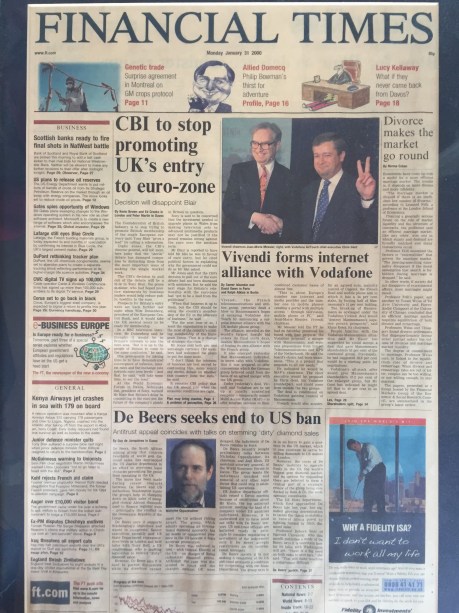
2015-06-06 17.35.25


The CBI is now arguing that Britain should stay in the EU on any terms. This view is out of whack with the general view of British businesses but the cabal that controls the CBI has never cared about this and the BBC has very rarely challenged them.

The CBI has also just announced that Cridland will be replaced by a former ‘head of strategy’ at the BBC and ITV. Mike Rake said, without apparent irony, that she has ‘an impressive background as an economist, journalist, management consultant and policy strategist’. The CBI represents hired managers, management consultants, lawyers etc – it has never represented successful entrepreneurs. It is always controlled by a small number of politically powerful multinational firms (generally run by non-entrepreneur hired managers) that can be crucified by the Commission. This is why they are not taken seriously as the ‘voice of British business’ other than, unfortunately, by the BBC.

The people who control the CBI should consider 1999. Unless the CBI changes its position, 1999 will be a picnic compared to 2016.

6. Business for Britain has serialised a big report on the economics of the EU which will be published in full shortly.

7. The Greeks have voted NO. Those in the Commission, Eurostat, and other EU institutions who colluded with Goldman Sachs and others to cheat the numbers to ease Greece into the euro have got away with it. The euro financial system was set up so that a lot of bankers made a lot of money out of artificially low Greek bond prices. What about when the music stops? IBGYBG (‘I’ll be gone, you’ll be gone’ as assholes in the City say to each other when ripping off their clients/customers.) Those like Mandelson who predicted the euro would be great for Greece still have their huge pension pots paid for by taxpayers and are invited on TV to pontificate about the EU, largely un-reminded by the BBC of their previous duff predictions.

There are deep problems with the global financial architecture, from China’s shadow banking system to the recurrent flash crashes driven by high frequency algorithmic trading. There are deep problems with the euro financial architecture. Since 2008 global debt has increased enormously. There has been a huge distortion of debt markets with investors holding massive quantities of government bonds that offer very little future reward and great future risk. CDO’s, CDS’s, all sorts of synthetic credit derivatives that contributed to the 2008 crisis are back and being sold to idiots who don’t understand them by some of the same people who used such complicated scams to cheat the figures for Greece’s euro entry. Bureaucrats keep bailing out financiers. The public quite rightly rages that ‘us idiots on PAYE are bailing all these crooks out’. Politicians largely ignore them. In Britain, Cameron even defended the indefensible non-dom rules and has done nothing about the grotesque abuse of executive pay by hired managers paying themselves as if they are successful entrepreneurs, with institutional shareholders happily pushing the merry-go-round and getting their kickbacks. Everywhere one looks one sees insiders ripping off the public and politicians either colluding or helpless spectators.

The EU system is, characteristically, not admitting its own terrible errors that have contributed to the destruction of the Greek economy. Even the IMF has told the EU that Greece’s debts are unsustainable and will need a haircut. But the EU leaders feel they cannot face this reality because it would lead to an explosion of demands from Spain, Portugal, and Italy. Instead of facing reality, Europe’s leaders have decided to turn the disaster into a morality play in which ‘the lazy Greeks’ are blamed for  everything. Meanwhile, Brussels’s real answer is the Five Presidents Report (above) – deeper and further integration because, after all, as Delors said the whole point of doing EMU before political integration was that the problems with the former would force the creation of the latter, like Athena from the head of Zeus.

(I have written elsewhere about the fundamental problem that the 21st century global system has become too complex for traditional states with traditional bureaucracies to cope with, and the need for very different kinds of political institution and very different training for political decision-makers. In other fields, there is innovation: for example, JSOC and UK special forces have completely changed how they operate to cope with networked enemies. In politics, there is almost no innovation partly because incentives are set up that reward people for failing conventionally, a political equivalent to ‘nobody gets fired for buying IBM’.)

*

The combination of no Treaty change and no substantial demands is no surprise to many. The EU timetable always made Treaty change practically impossible before the end of 2017 (other than an Article 48 minor change to lower order things, which NB. could allow DC to claim ‘I’ve got treaty change’). However, Cameron’s position since his Bloomberg speech has relied on teasing the media, his MPs, donors and others that he intended to fight for treaty change to show he was ‘serious’.

He has decided to drop this pretence at the start of the process. His approach since the election has helped rally support for the NO campaign as it becomes increasingly clear that his talk of ‘fundamental change’ was just to keep people onside before the election. Some Conservative Party donors, who have suspected for a long time that the Cameron-Llewellyn team does not know how to negotiate, can see there is no serious attempt to reshape our membership. This is particularly striking given that the combination of the Greek crisis and the African/Med migrant crisis is pushing the EU itself to consider a new Treaty and new arrangements for the non-euro countries.

This approach is also unpopular with some of Cameron’s spads in No10 and Cabinet ministers who think that Llewellyn – a diehard pro-euro/EU campaigner – is harming the prime minister with his approach. Some of them think that rushing it also means rushing the day of DC’s departure as the leadership campaign will effectively start after the referendum. Others have pointed out that rushing so transparently to get trivial changes is hardly the best way to win a YES vote – or to maintain good faith in, and good will for, the prime minister. So far Llewellyn is ignoring such criticism – if he hears it, which is perhaps unlikely given how No10 works. No10 spads are keen to stress to journalists that ‘Ed is completely in charge of this, my responsibilities are domestic only if you know what I mean’.

On the referendum #8: Unprofessional pundit – Adam Boulton

I thought a few weeks ago I would keep track of some pundits writing on the referendum (cf. the errors of Steve Richards here).

A few texts yesterday told me to read Adam Boulton’s Sunday Times column:

‘In anticipation of a Greek no, Britain’s “no” champions are urging Cameron to play hardball. They are cheered by the appointment of Dominic Cummings to kick-start the campaign. He is advocating a Syriza-style approach, suggesting that if Britain votes no it will still be possible to renegotiate and hold a second referendum to stay in. Cameron must crush this argument fast if he is not to be undermined among Tory activists. A “yes” vote in Greece followed by firm discipline for Athens would do that. In the meantime, he could point out that Cummings’s strategic brilliance at the education department led to him losing his job and almost cost the career of his master, Michael Gove.’

A few other hacks have called to say that a No10 spad is claiming I was fired from the DfE, while another one claims I was ‘secretly’ fired but allowed to claim I resigned. (Great message discipline Dre.)

If Boulton had googled or called, he would have realised he’d been lied to.

Facts? In September 2013 I told Gove I was resigning from the DfE  but would stay for a few months to help the transition to a new team. In October 2013, it was reported in a few places (first by Tim Shipman) that I’d resigned. I stayed until 31 January 2014 to help replacements figure out how the DfE worked. Boulton would have seen this immediately if he had googled instead of parroted a briefing.

Boulton’s Syriza analogy is also silly. My point about a second referendum had nothing to do with Syriza and was written before the Greek referendum had even been announced.

Boulton has been surly towards me since we were on a platform together discussing the media in 2003. He got cross about criticisms of media professionalism. He’s obviously still struggling with basic fact checking.

I can use Google. Up pops straight away a Boulton prediction on the euro from 2001: ‘Britons will come round to the idea [joining the euro] once they’ve handled euro money’, a line that was straight out of the Blairite spin doctors’ briefing notes at the time. Blairite pundits like Boulton – like their sources Mandelson, Clarke et al – need to be reminded of their duff predictions on the euro when they wheel out all the usual stale conventional wisdom in the coming referendum.

Adam – next time clowns in No10 tell you stuff about the referendum, check to see if it’s true before you repeat it…

Ps. AB responds on Twitter: ‘So there’s no reason to be so pompous, tendentious and offensive. We just see things from different perspectives.’ Odd that he sees correcting factual errors as ‘offensive’. It’s struck me many times over the years how thin-skinned some hacks can be given how they’re always criticising others. Tetlock’s seminal study on ‘political experts’ famously showed that the more a pundit is on TV, the more likely they are to be wrong AND not to admit they’re wrong.


On the Referendum #7: Transparency for our Potemkin government – Memo to ministers and spads thinking about how you could help the NO campaign

There have been many attempts to quantify the extent to which EU law (primary, secondary, Regulations, Directives, ECJ judgements etc) really determines what happens in the UK. It is inherently hard to come to an agreed answer given the combination of a) the sheer scale and complexity of EU law’s entanglement with domestic law over decades including things like domestic court interpretations of ECJ judgements, b) different definitions of regulation and the units of measurement, c) the desire of the civil service to obscure the issue, and so on.

You – ministers and spads – can contribute something valuable to this debate in a way that will help the NO campaign at a crucial time.

For those not in government reading this… One of the basic mechanisms of government is the ‘Cabinet write round’ system. This involves Secretaries of State being given lots of documents every night in their box from other departments. The SoS is supposed to read these documents and tick the relevant box on the attached form signalling assent, disagreement, comments etc. (When I find a copy of one in my papers I’ll post a photo.)

For entirely domestic things, this process can lead to disagreement and negotiation. An interesting aspect of our membership of the EU is that a large fraction of the documents concerning future law and administrative action come from the EU. For reasons that are opaque, the civil service continues with the write round system. It is, of course, a Potemkin system as ministers do not have a real power to oppose anything – the document in question will become law regardless of how the minister fills in the chitty. Still, the chitties are sent around so everybody can pretend they are in charge. This is a depressing process for some ministers but perhaps the Cabinet Office regards it as a Pavlovian exercise – ministers become habituated to simply tick everything without engaging their brains or ethics.

When occasionally a SoS refuses, the first step is the Private Office asks whether a mistake has been made. No? Are you sure minister? Off the chitty goes to the Cabinet Office (‘very courageous minister’). Step 2 is that the Cabinet Office emails to say – ‘Was your SoS drunk again last night, he seems to have rejected the EU Directive on XXX, better go and tell him to withdraw his objection pronto or Jeremy [Heywood] will be on it.’ This is normally enough to get SoS scuttling to retract his objection. Stage 3 is unusual – it involves the SoS not giving in at Stage 2. What happens then is that the SoS is informed by the private office that Ed Llewellyn has said that the Prime Minister agrees with Jeremy and insists on measure X. This flattens practically all objections. I have witnessed the very unusual Stage 4 – the SoS sends back a message asking for a meeting with Jeremy. Jeremy arrived. ‘This is EU law so there is no basis for us to object.’ Gove: ‘Why do we get sent these stupid forms to fill out then if we can’t stop these awful things, this is going to waste hundreds of millions of pounds for nothing?’ Jeremy [a chuckle]: ‘Haha, yes, so I’ll inform the Prime Minister that you agree after all, we will mention to European officials that ministers have grave concerns, I’m sure Oliver will look at it further, goodbye Michael.’ Game Over: ‘All your base belong to us’, as the old video game said…

The fairy tale that Britain still has Cabinet government involves maintaining this Potemkin process.

I have asked No10 spads a few times over the years what proportion of things they see come from the EU. The estimates have been 50-60%. When I was in the DfE, I would occasionally do surveys of Gove’s box, going through every single paper in it, to see the proportion of EU stuff. I would estimate the same – typically about half, though sometimes much more (though obviously volume does not equate to importance).

With the referendum coming, this will be an important question. The usual surveys will not answer the question. So what could you do?

From now, start collecting stats on a daily basis of the proportion of EU stuff in the box. Spad, create a GoogleDoc – obviously do not use the official system – so that the minister can simply fill in the box on the grid for each day. For the minister (or you) to jot ‘x%’ each day and fill in a GoogleDoc grid will take no more than a few seconds per day, less than a minute per week, less than an hour in a year. (If they are technically hopeless just get him to jot a figure and you fill it in.)  Also, you could take a few photos of some of the boxes (‘This one was 80% EU stuff’) and save them to Dropbox for future use. Keep copies of the 1% most stupid, irrational, and wasteful things. Add ECHR/HRA stuff too – that is all relevant particularly given Cameron is going to do nothing at all about the Charter of Fundamental Rights (NB. this is the EU thing, not the ECHR). No officials will know you are doing it. Neither Heywood nor Llewellyn will be able to know you are doing it.

After Cameron returns from the EU proclaiming triumph and some of you resign, you will then have a record of contemporaneously collected stats on the real importance of EU affairs in Government. You will be able to publish this. It will be recorded over a year or so and therefore have hundreds of data points. Much more than other surveys on this question, people will take it seriously – particularly when you explain it at a press conference holding up some photos and copies of the most stupid documents. It will be impossible for No10 to rebut it effectively. They will not be able to publish documents that could refute it. Heywood will give a statement saying that your claims are wrong but nobody will believe him.

This is a simple thing that could have a significant impact at the right time. You all know how much EU stuff is hidden by Whitehall and how much effort goes into pretending that ministers decide things that were really decided by some lobbyist in a Brussels hotel years ago. You know these Kafka-esque bureaucratic processes, redolent of the dying days of the Austro-Hungarian Empire, that characterise modern Whitehall. DO SOMETHING ABOUT IT!

Lots of you now won’t know whether you are going to resign but you can do this without anybody knowing so you have something useful if you do decide to resign; if you don’t you can delete it all, no harm done. Boris, we know you read this blog, you could do the same thing in the Mayor’s office and surely there will be some committees Cameron puts you on shortly to try to keep you quiet…

Please suggest ideas about how to improve this process,

Dominic